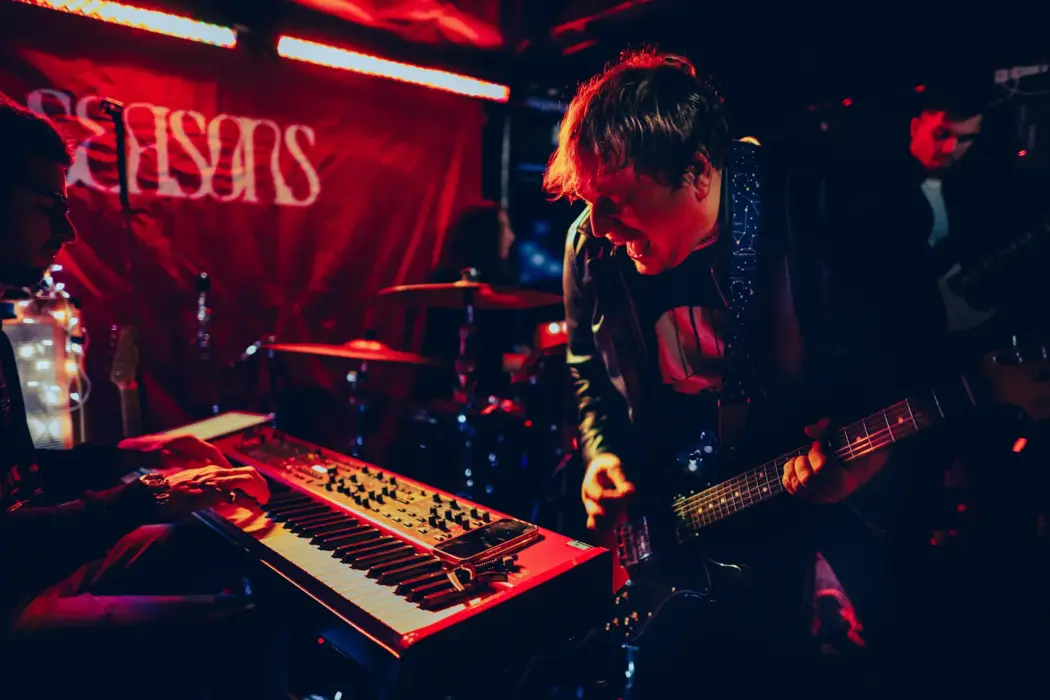
We sat down for an interview with Lázár Lobó-Szalóky, founder, lead singer, and guitarist of the band Dirty Slippers.
Festivalstalker: For those who aren’t familiar with you yet, how would you describe Dirty Slippers and your musical style to someone who is hearing your music for the first time?
Lázár Lobó-Szalóky: I would describe Dirty Slippers as a Hungarian indie rock band with a British musical soul, big melodies, emotional lyrics and an enormous passion for live music.
Our sound is somewhere between melodic indie rock, punk rock and arena rock. We love powerful guitars, massive choruses and songs that audiences can sing together, but we also believe that music should have something meaningful to say.
For us, a great rock song should work in two completely different situations: when you’re standing in front of thousands of people at a festival, and when you’re alone in your bedroom, going through a difficult moment in your life.
We’ve worked with internationally respected producers including George Shilling (Oasis, Frank Turner) and Tim Palmer (Bon Jovi, Goo Goo Dolls, U2) , recorded at Abbey Road Studios in London, and built a growing audience in the United Kingdom and across Europe.
But at the heart of everything, we’re still four musicians who believe that rock music can change someone’s day — or sometimes even their life.
We want to make music that sounds big but feels personal.
Festivalstalker: You’re from Hungary and have developed your own musical identity there. How has your home country influenced your music and your development as a band?
Lázár Lobó-Szalóky: Hungary is a huge part of who we are, even though our musical influences have always reached far beyond its borders.
Growing up in Hungary and trying to build an international rock career teaches you something very important: determination. You don’t necessarily have the same opportunities or music-industry connections as a band starting out in London or Manchester. You have to work incredibly hard to make yourself heard.
But I think that experience has given Dirty Slippers a particular character. We’ve never wanted to imitate a British or American band. We want to bring our own experiences, emotions and musical identity into an international sound.
I also believe Hungarian music has a strong tradition of melody and emotional storytelling. Those qualities are important in our songwriting. We listened to the big names of Hungarian 60’s beat music like Illés and the best bands from the 90’s like Republic. I think I learned a lot of them.
I’m proud that we come from Hungary. When our song „The Best“ reached number one on Burton Radio‘s weekly chart in Britain, it was a very special moment for us.
It showed that your passport doesn’t define how far your music can travel.
Festivalstalker: You’ve recorded music at the legendary Abbey Road Studios. What does it mean to you to work in a place that has made music history? Many musicians dream of recording at Abbey Road Studios. How did this opportunity come about, and what was your first thought when that dream became a reality?
Lázár Lobó-Szalóky: Abbey Road is one of those places that almost every musician dreams about, but very few genuinely expect to become part of their own story.
When you think about the incredible musical history connected to those studios — The Beatles, Oasis, Pink Floyd and so many legendary recordings — it’s difficult to describe what that means as an artist.
For us, reaching Abbey Road was the result of years of persistence, building our international relationships and refusing to give up on our ambitions as an independent Hungarian band.
We didn’t come from a major international record-label machine. We’ve built much of our career step by step, investing enormous amounts of time, energy and personal commitment into our music.
What makes Abbey Road special isn’t simply the famous name on the building. It’s the atmosphere, the professional standards and the feeling that you’re working in a place where music has always been taken seriously. I am an old school analog guy, that place with the old recording stuff means the world. I am really happy and thankful because the music sounds exactly as I envisioned
Being there reminded me why I became a musician in the first place.
The biggest lesson of Abbey Road was that dreams shouldn’t become smaller just because you come from a smaller music market.
Instead, you should work until your ambitions become possible.
Festivalstalker: Has working with George Shilling changed your approach to songwriting, arrangements, or music production?
Lázár Lobó-Szalóky: Absolutely. Working with George Shilling has been an incredibly important part of our artistic development.
George has worked with remarkable artists, including Blur, Oasis and Frank Turner, but what makes him special to me isn’t simply his impressive list of credits. It’s his musical sensitivity.
He understands that the most important thing in a song is its emotional identity.
As musicians, we sometimes think a song needs more guitars, more arrangements, more layers, more everything. But a great producer can show you that the most powerful moment might actually come from giving a melody more room to breathe.
Working at that level encourages you to become more demanding of your own songwriting. You start paying attention to every detail: whether a chorus really connects, whether a vocal performance feels honest and whether each instrument has a reason to be there.
George has helped us think more internationally about the quality and identity of our recordings while preserving what makes Dirty Slippers our own band.
A great producer doesn’t turn you into somebody else. He helps you become the strongest version of yourself. That’s the reason he is still with us since 2009. We feel the same emotions during the recordings, George is breathing with my feelings every time.
Festivalstalker: Was there a particular moment during the recording sessions when you realized that working together had taken your songs in a new direction?
Lázár Lobó-Szalóky: For me, the biggest change wasn’t necessarily one dramatic moment. It was the gradual realisation of what our songs could become when we approached every detail with that level of care.
There’s something fascinating about hearing music you’ve written develop beyond the version that originally existed in your head.
A song might begin with a simple guitar, a melody and a few lines of lyrics. Then, through the recording process, it starts to develop a much bigger emotional and musical identity.
What I found especially inspiring was the balance between ambition and simplicity. We wanted the recordings to sound powerful and international, but never artificial.
Sometimes the smallest musical decision can make the biggest emotional difference.
That experience changed the way I listen to our own songs. Today, I’m interested not only in whether something sounds impressive, but whether it makes the listener feel something.
Because ultimately, people won’t remember how many guitar tracks you recorded.
They’ll remember how the song made them feel.
Festivalstalker: Your new album, “Wide Open,” is set to be released in February 2027. What’s behind the title, and what story do you want to tell with the album?
Lázár Lobó-Szalóky: First, there’s one small distinction I’d like to make: „Wide Open“ is one of our most important singles, while we’re currently preparing our fourth studio album, planned for February 2027. It will be our first album consisting entirely of English-language songs.
„Wide Open“ is particularly important to me because its message represents so much of what Dirty Slippers stands for.
It’s about those moments when life seems incredibly difficult, when you feel uncertain about your future or overwhelmed by the expectations of the world around you.
Growing up isn’t always easy. Sometimes you feel that every door is closing in front of you, and you don’t know which direction to take.
But the song is about finding the courage to keep going.
That’s also a central emotional theme in our new material: resilience, hope, relationships, bad decisions, personal struggles and the belief that even the most difficult experiences can become the beginning of something better.
Working with people such as George Shilling and Tim Palmer has helped us develop the international sound we’ve been searching for.
Our ambition is to make an album that feels both powerful and deeply human.
I don’t want people to listen to our songs simply because they sound good. I want them to feel less alone after hearing them.
Festivalstalker: What role did recording at Abbey Road Studios and working with George Shilling play in shaping the sound of “Wide Open”?
Lázár Lobó-Szalóky: The Abbey Road experience and our work with George Shilling helped establish the musical standards and direction we wanted to achieve as a band.
With „Wide Open“, we wanted something very specific: an uplifting, guitar-driven arena rock anthem with the energy of a live performance, but also the emotional depth of a very personal song.
Tim Palmer‘s involvement was another significant part of that international creative journey. He’s worked with artists such as U2, Pearl Jam and Bon Jovi, and his experience brings a wonderful understanding of powerful, melodic rock music.
The challenge with a song like „Wide Open“ is finding the right balance. It needs to sound enormous without losing the vulnerability at the centre of its message.
We’ve always loved music that can fill a stadium but still feel like somebody is speaking directly to you.
That was the spirit we wanted to capture.
The song received its UK radio premiere on Planet Rock, which is the biggest rock radio in the UK and seeing it gain support internationally has been incredibly encouraging.
For us, the perfect rock anthem isn’t just a song that makes people raise their hands. It’s a song that makes them believe in themselves again.
Festivalstalker: Is there a song on “Wide Open” that means a lot to you personally, or one whose reception you’re particularly excited to see?
Lázár Lobó-Szalóky: „Wide Open“ is certainly one of the songs that means the most to me because of the message behind it.
When I think about the young people we’ve met through Suliturné, I remember how many of them are dealing with pressures that adults often underestimate.
Bullying, loneliness, insecurity, problems at home, fear of failure — these are real challenges, and sometimes a young person doesn’t know where to turn.
That’s why songs about resilience matter so much to me.
We’ve been running Suliturné since 2011, combining live rock music with conversations about important social issues. We’ve now reached more than 300,000 young people across over 800 schools and educational institutions.
What fascinates me is the connection between the stage and those school visits. The same song can mean one thing to somebody at a rock concert and something completely different to a teenager who is having a very difficult week.
That’s why I love what we do.
And, of course, I’m incredibly excited for people to discover the new songs from our forthcoming album.
I believe it’s some of the most ambitious music we’ve ever created.
Festivalstalker: Germany is an important music market for many international bands. How would you describe your connection with German audiences so far?
Lázár Lobó-Szalóky: Germany has always been an incredibly important country for rock music, and we have enormous respect for its musical culture. We toured in the country twice and played at legendary venues like Markthalle Hamburg or Glasshaus Bayreuth.
What I particularly admire is the way German audiences support live music, guitar-based bands and festivals. There’s a genuine appreciation for musicianship and for bands that have something meaningful to say.
For Dirty Slippers, Germany is one of the countries where we’d really love to develop a stronger connection with audiences.
We’re currently expanding our relationships with German music journalists, radio stations, festival organisers and industry professionals, and we’re very encouraged by the interest we’ve received.
There’s also a special connection through Suliturné. One of the musicians supporting our programme is Ingo Knollmann from the German punk-rock band DONOTS.
Having artists from different countries supporting our educational work means a lot to us.
I believe Germany could become an important home for both sides of Dirty Slippers: our live music and our commitment to working with young people.
We don’t want to visit Germany just to play a concert and leave. We want to build a real relationship with German audiences.
Festivalstalker: Can you imagine performing more frequently in Germany around the release of “Wide Open”, or even going on a tour of your own?
Lázár Lobó-Szalóky: Absolutely! In fact, that’s exactly the direction we want to move in during 2027.
We’re preparing our new English-language album and developing our European touring plans, with Germany among our priority markets.
I would love to see Dirty Slippers performing at German festivals, independent rock clubs and larger live-music events, connecting with audiences who are discovering our songs through radio and online media.
Our experience performing in the United Kingdom has shown us how exciting it is to introduce our music to new audiences. We’ve played in cities including London, Edinburgh and Newcastle, and we’re continuing to build our international live presence.
Germany would be a fantastic next chapter.
And I have another ambition beyond the concerts.
I’d love to bring Suliturné to German schools as well, working with educational institutions, local organisations and partners who believe in the power of music to connect with young people.
Imagine playing a rock show in a German club in the evening, then visiting a school the next morning to speak with students about music, confidence and the challenges of growing up.
For me, that would be something truly meaningful.
Dirty Slippers started as a dream of making music that could reach people beyond Hungary.
Today, that dream is becoming increasingly international.
And I genuinely believe our biggest chapter is still ahead of us.
So Germany, we hope to see you very soon!
Rock on!